What oestrogen does for skin
Oestrogen is not a cosmetic hormone that happens to affect skin at the margins. Skin is a genuine target organ, rich in oestrogen receptors, and the hormone supports collagen synthesis by fibroblasts, dermal thickness, hyaluronic acid production and water content, sebum output, barrier function and wound healing. While oestrogen is present at premenopausal levels, these processes run quietly in the background and are easy to take for granted.
The menopause transition removes that support over a relatively short window, which is why many women describe skin change that feels sudden rather than gradual. The often-quoted figure that skin loses around 30 per cent of its collagen in the first five years after menopause traces back to a small body of older studies and should be treated as an estimate rather than a precise law, but the direction and the steepness of the early decline are well accepted in the dermatological literature indexed on PubMed. After the initial drop, collagen continues to decline at a slower rate with age.
What changes at menopause, specifically
The changes women most commonly report, and which the research base supports, are worth separating, because they respond to different things.
- Dryness and rough texture. Reduced sebum and reduced dermal water content. The most universal complaint and the most treatable.
- Thinning and fragility. Loss of dermal collagen and thickness, visible as crepiness, easier bruising and slower healing.
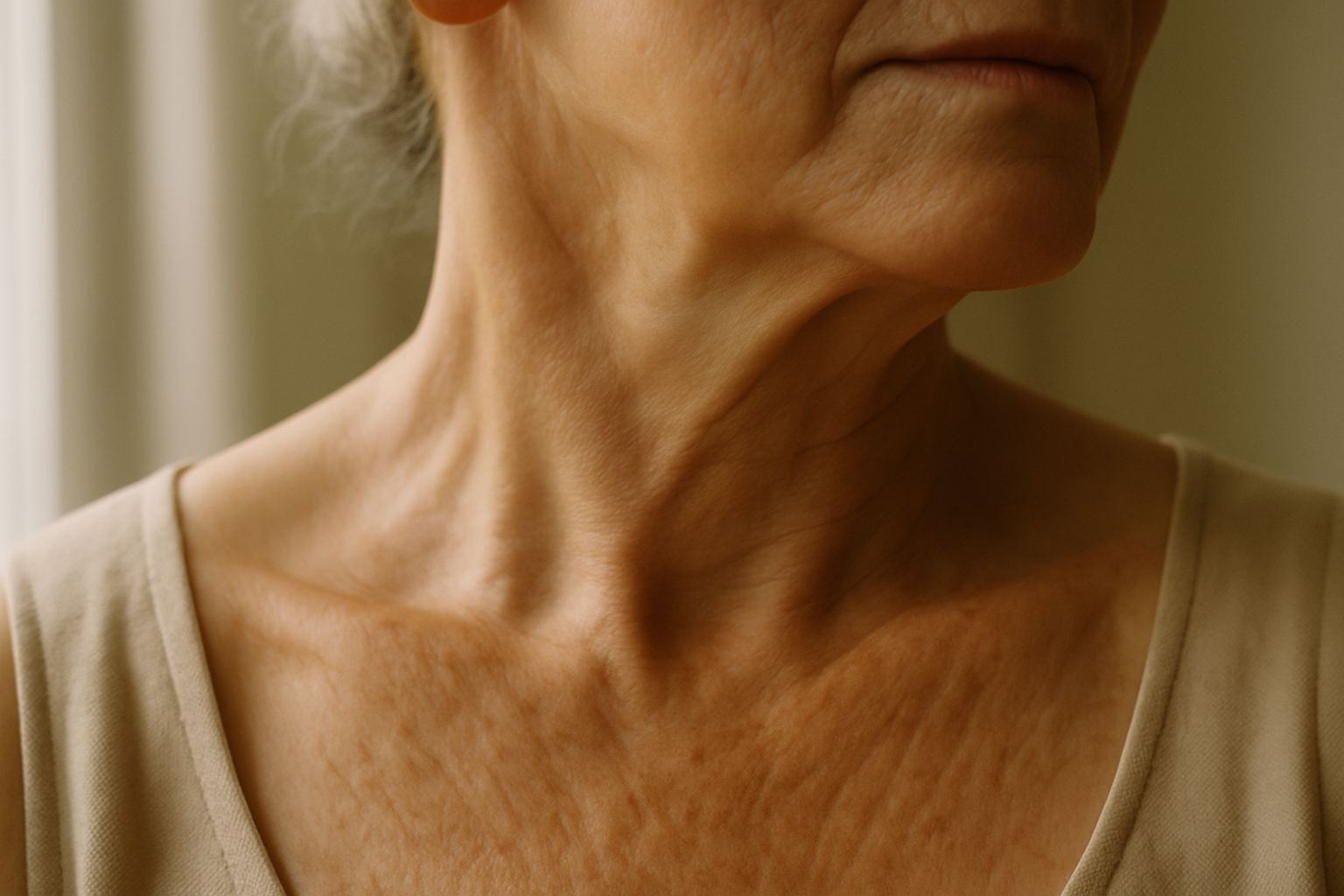
- Loss of elasticity and firmness. Declining collagen and elastin quality, showing as sagging along the jaw and neck rather than as individual lines.
- Accelerated wrinkling. The interaction of hormonal change with accumulated sun damage, which menopause unmasks rather than causes.
- Flushing and reactive skin. Vasomotor symptoms overlap with rosacea territory, and some women develop new redness or sensitivity.
- Hormonal acne and facial hair change. The shifting oestrogen-to-androgen balance can produce breakouts and coarser facial hair even as scalp hair thins.
One clarification that saves confusion in clinic: menopause did not create the sun damage that becomes visible in the fifties. It removed some of the scaffolding that was masking it. This is why photoprotection remains central even at this stage, and why before-and-after expectations need calibrating against decades of ultraviolet history, not just hormone levels.
The HRT context, without prescribing advice
No article on menopausal skin is complete, or straight with its readers, without addressing hormone replacement therapy, and none written by an aesthetics publication should offer prescribing advice. Both things are true, so here is the context and only the context.
The UK has a national clinical guideline on menopause diagnosis and management, published by NICE, which sets out when HRT should be considered, its benefits for menopausal symptoms, and its risks, which differ by age, health history and formulation. Decisions about HRT belong in a consultation between a woman and her GP or a menopause specialist, informed by that guideline and by resources from the British Menopause Society. Skin changes alone are not listed as an indication for starting HRT.
Within that frame, the evidence picture is worth knowing: studies of women taking systemic oestrogen show measurable effects on skin, including increased dermal collagen and thickness and improved elasticity and hydration, with the clearest effects when treatment starts near menopause. The studies are mostly small and older, and skin outcomes have never been the primary purpose of HRT research. The fair summary is that many women prescribed HRT for their symptoms notice skin benefit alongside, and that this is biologically expected, not imagined. What no reputable clinician will do is prescribe systemic hormones for cosmetic purposes alone, and an aesthetic practitioner who suggests otherwise has left their lane. Vaginal oestrogen, for completeness, acts locally and is not a skin treatment.
Skin benefit from HRT is biologically expected and often observed, but skin alone is not an indication, and prescribing belongs with GPs and menopause specialists.
Topicals with evidence behind them
The topical evidence for ageing skin generally applies to menopausal skin specifically, with barrier care promoted up the priority order.
Daily broad-spectrum SPF remains the highest-value habit, defended consistently by the British Association of Dermatologists. Retinoids retain the strongest evidence of any topical for photoageing, with the practical caveat that thinner, drier menopausal skin tolerates them less easily, favouring lower starting strengths, buffering with moisturiser and slower escalation. Well-formulated moisturisers built on glycerin, hyaluronic acid, ceramides and urea address the dryness that drives much of the day-to-day discomfort. Niacinamide has reasonable evidence for barrier support and tone. Topical phytoestrogen creams occupy a greyer zone: plausible mechanism, small studies, and products that sit close to the cosmetic-medicine borderline policed by the MHRA. They are not a substitute for any of the above.
Clinic treatments: what helps and in what order
Clinic treatments can do real work on menopausal skin, but order matters more here than in younger patients, because the tissue being treated is drier, thinner and slower to heal.
| Stage | What | Why this order |
|---|---|---|
| 1. Foundations | SPF, retinoid, barrier repair, menopause care via GP where relevant | Everything later depends on skin that is protected and functioning |
| 2. Skin quality | Skin boosters, polynucleotides, microneedling, gentle peels, laser for redness | Hydration and dermal quality respond first and improve tolerance of later steps |
| 3. Structure | Biostimulatory injectables, volume replacement where genuinely indicated, energy-based tightening | Structural work on poor-quality skin disappoints; on prepared skin it reads naturally |
| 4. Maintenance | Spaced repeat sessions, annual review | Menopausal skin change is progressive, so plans should be too |
Our evidence review of polynucleotides is directly relevant at stage two, since menopausal skin quality is one of the indications where the early data is most interesting and where the marketing is furthest ahead of it. Budgeting across a staged plan is covered in our UK cost guide. And a consultation for any of this should include a menopause history: a practitioner who does not ask about your menopausal status, HRT use and healing history before injecting or lasering is missing information that changes both plan and risk, which is one of the patterns in our consultation red flags checklist.
What deserves scepticism
Menopause is a large, newly fashionable market, and skin claims have followed the money. Reasonable scepticism applies to: supplements marketed as collagen banking with no outcome data; hormone-balancing facials, a phrase with no defined mechanism; device packages sold in large prepaid courses to a group specifically experiencing slower, less predictable treatment response; and any clinic offering hormonal testing or prescribing outside a proper medical framework. The pattern to hold onto is familiar from the rest of aesthetics: the interventions with the best evidence, photoprotection, retinoids, barrier care, and properly indicated medical menopause care, are the least glamorous and the least profitable to sell.
When to see a GP or dermatologist
Some changes in midlife skin belong in medical rather than aesthetic hands. New or changing pigmented lesions, persistent facial rashes, sudden severe acne, scarring hair loss and non-healing spots all warrant a GP consultation and, where needed, dermatology referral. Menopausal symptoms themselves, sleep disruption, flushing, mood change, joint pain, deserve a proper medical conversation informed by the NICE guideline, not a skincare aisle. The best aesthetic outcomes in this decade of life sit on top of good medicine, not in place of it.