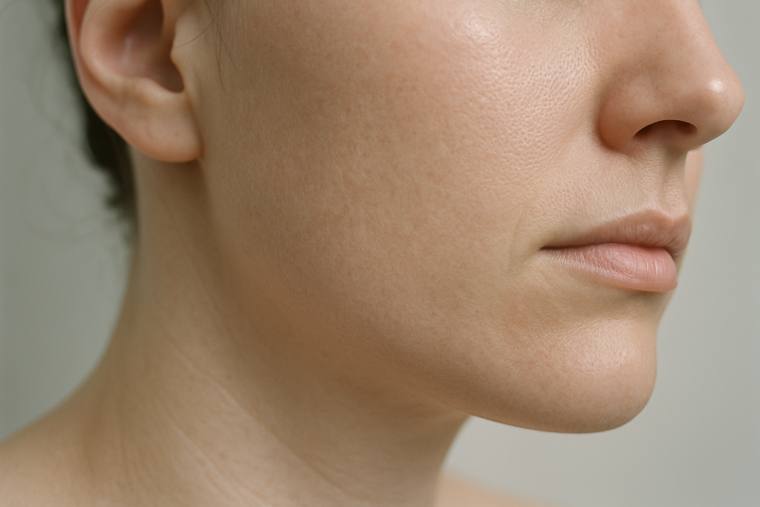
How RF microneedling works
Radiofrequency microneedling combines two mechanisms in one device. First, fine needles penetrate the skin, creating the micro-injury that underlies standard microneedling. Second, radiofrequency energy is delivered from the needle tips into the surrounding dermis, heating it to a temperature that denatures collagen and triggers a remodelling response.
The addition of heat is the point. Standard microneedling relies on mechanical injury alone; adding radiofrequency delivers a thermal stimulus to the dermis that, in principle, drives stronger collagen contraction and neocollagenesis. Many devices use insulated needles so that the energy is released only at the tip, sparing the epidermis and reducing the pigment risk that surface heating would carry.
The combination is worth understanding as two effects with different timescales. The mechanical needling and the thermal injury both provoke a wound-healing response, but the heat adds an immediate contraction of existing collagen alongside the slower laying down of new collagen over the following months. In theory that should make radiofrequency microneedling more effective than needling alone for laxity, and the mechanism supports the idea. The gap, as with most energy devices, is between that plausible mechanism and the size of the effect actually demonstrated in controlled studies, which is more modest than the marketing suggests.
That epidermal sparing is why the category is often promoted as suitable across a wider range of skin types than ablative laser. The claim is reasonable in principle, though it depends on the device and the settings used.
There is a design distinction worth understanding. Some devices use insulated needles, releasing energy only from the exposed tip deep in the dermis, while others use non-insulated needles that deliver energy along their whole length. Insulated needles concentrate heat where it is wanted and spare the upper skin, which is the safer configuration for darker skin. It is a more meaningful difference than the brand name, and a patient who wants to ask one technical question at consultation could do worse than to ask whether the needles are insulated and at what depths they will be used.
The category, not just one brand
Morpheus8 is the name most patients arrive with, to the point where it is often used as if it were the treatment itself. It is not. It is one brand within a category that includes several radiofrequency microneedling devices, each with its own needle configuration, depth range and energy delivery.
Booking a brand name is not the same as booking a result. The device matters less than the depth, the settings and the person holding it.
This matters for two reasons. First, a patient fixated on one brand may overlook an equally capable device in a better clinic. Second, the brand name is sometimes used to justify a premium that reflects marketing rather than a superior outcome. The sensible questions are about needle depth range, how many treatments are proposed, and the practitioner's experience, not which logo is on the handpiece.
The strength of a single brand name in this category also creates an odd market effect. Because so many patients search for one product by name, clinics have a strong incentive to advertise it whether or not it is the device they would otherwise choose, and some patients pay a premium for the name attached to a treatment that a differently branded device would deliver equally well. None of this is to disparage any particular device. It is to make the point that the brand has become a marketing anchor, and a patient who treats it as a proxy for quality is likely to overpay.
What the evidence supports
The published evidence for radiofrequency microneedling is positive but should be read with the usual caution about aesthetic device studies. Trials and case series indexed on PubMed report improvement in skin texture, mild to moderate laxity, acne scarring and enlarged pores, with a generally favourable safety profile.
The caveats are consistent across the category:
- Sample sizes are typically small, often twenty to fifty patients
- Many studies lack blinded assessment or a control group
- Follow-up rarely extends beyond twelve months, so durability is poorly characterised
- A number of studies involve device manufacturers
None of that means the treatment does not work. It means the confidence around specific claims is wider than the marketing implies, and a claim of dramatic lifting should be treated with scepticism. The reasonable reading is that RF microneedling delivers modest to moderate improvement in the right patient, not a surgical result. The same evidential caution applies across the energy-device field, as our review of what the Endolift evidence actually shows sets out.
Who genuinely benefits
The best candidates are patients with early to moderate skin laxity, textural irregularity or acne scarring, whose skin quality is still reasonable. Someone with mild jowling and good skin elasticity may see a worthwhile improvement. Someone with significant skin redundancy will not, and is a surgical candidate being sold a device treatment if told otherwise.
| Concern | Suitability | Note |
|---|---|---|
| Texture and pores | Good | Among the better-documented uses |
| Acne scarring | Good | Improvement, not erasure |
| Mild to moderate laxity | Moderate | Realistic if skin quality is reasonable |
| Significant laxity or redundancy | Poor | Surgical territory |
| Deep static wrinkles | Limited | Better addressed by other means |
Risks and downtime
RF microneedling is generally well tolerated. Common effects are redness, swelling, pinpoint bleeding and a grid-like marking that settles over a few days. More significant complications, including burns, scarring and pigment change, are largely operator-dependent and related to excessive energy or incorrect depth.
Downtime is short compared with ablative laser, usually two to four days of redness and swelling. Most protocols involve a course of around three sessions spaced roughly a month apart, with results building over the following months as collagen remodels. Anyone judging the outcome at two weeks is judging it too early.
Combination treatment is common and deserves scrutiny. Radiofrequency microneedling is frequently packaged with topical products, or paired with other devices, in a way that makes it hard to know what is doing the work. As with standard microneedling, a patient should separate the core treatment, which has a reasonable evidence base, from the add-ons layered on top, which often do not. Asking what each element contributes, and what it costs on its own, is a fair way to test whether a package is built around evidence or around margin.
Cost and choosing a clinic
UK pricing in 2026 runs from roughly £450 to £1,200 per session depending on area, device and location, with a full course therefore reaching well into four figures. Our guide to what aesthetic treatments cost in the UK in 2026 places this alongside other skin treatments. Premium pricing attached to a particular brand name is worth questioning if it is not matched by practitioner experience.
It is also worth setting radiofrequency microneedling against its neighbours before committing. For a patient whose concern is genuinely texture and mild laxity, standard microneedling is cheaper and may be sufficient, while for more advanced laxity the treatment will underdeliver against surgery or, in the right case, an energy device that works at a deeper plane. The category occupies a real middle ground, but that middle ground is narrower than the marketing implies, and a candid practitioner will place a meaningful number of enquirers on either side of it rather than inside it.
Because the treatment delivers thermal energy through needles into the dermis, the operator's training is the main determinant of both safety and result. Verify the practitioner on a public register or an accredited voluntary one, and ask directly how many treatments they have performed on the device in question. Our explainer on what an aesthetic clinic actually means in UK law covers how to do that, and the MHRA regulates the devices themselves.