Why the under-eye is different
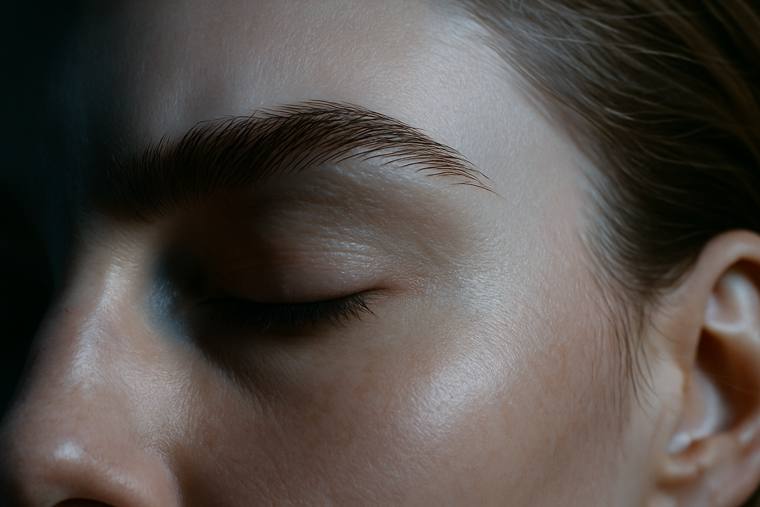
The tear trough is the groove running diagonally from the inner corner of the eye across the top of the cheek. Anatomically it is a genuinely awkward place. The skin here is the thinnest on the face, a fraction of a millimetre in places, with little fat beneath it to hide anything placed there. A tight band of tissue, often called the tear trough ligament, tethers skin towards bone and creates the groove. Immediately above sits the orbital fat that produces eye bags when it bulges; immediately deep run branches of vessels that connect with the eye's circulation.
Add two further problems. Lymphatic drainage under the eye is sluggish, so anything that attracts water tends to stay swollen, and hyaluronic acid attracts water by design. And the area is lit badly by daily life: overhead lighting throws every contour into shadow, so millimetre-level irregularities that would vanish anywhere else on the face are visible here.
Every one of those facts narrows the margin for error. None of them appears in the marketing.
Who is actually a candidate
The good candidate for tear trough filler is specific: a younger patient with a true volume hollow, thick and elastic overlying skin, no under-eye bags, no tendency to morning puffiness, and realistic expectations. In that patient, small deep deposits of a low-water-attracting filler can soften the groove convincingly.
Most people asking about the treatment are not that patient. Dark circles caused by pigmentation or visible vessels will not improve with volume, because the colour is in the skin, not the shadow. Bulging fat pads need the bag addressed, not the valley beside it filled, or the whole under-eye simply moves forwards. Loose, crepey skin drapes worse over added volume. Patients prone to fluid retention often find filler turns intermittent puffiness into permanent puffiness.
The best tear trough injectors are defined less by how they fill the area than by how often they decline to.
A consultation that does not involve looking at your under-eyes in the morning, asking about allergies and fluid retention, and pinching the skin to test its thickness is not a candidacy assessment, it is a booking.
The Tyndall effect
The signature under-eye complication has a name from physics. When hyaluronic acid gel sits too superficially beneath thin skin, the gel scatters short blue wavelengths of light more than long ones, and the skin over it reads as a bluish grey tint. The patient arrives complaining of dark circles and leaves, months later, with different, bluer dark circles.
Three things make Tyndall discolouration particularly unwelcome. It does not fade with the filler's advertised lifespan, because under-eye filler is notorious for persisting for years. It is worst in exactly the lighting patients care about, daylight and photographs. And it cannot be corrected by adding anything; the only fix is dissolving the product entirely and starting again, or not.
The other ways it goes wrong
- Chronic malar oedema. Persistent puffiness over the cheekbone where filler and poor lymphatic drainage combine. Often worse in the mornings, and often resistant to everything except dissolving.
- Lumps and irregularity. Thin skin hides nothing. Product placed unevenly, or which shifts, shows as visible beads or ridges.
- Overfill. A filled trough that reads as a sausage of fullness under the eye, sometimes months later as the product draws in water.
- Migration. As with lips, product can track from where it was placed; the mechanics are covered in our piece on filler migration.
- Vascular events. Rare but serious. The under-eye's vessels connect with the eye's circulation, and intravascular injection can cause skin necrosis or, exceptionally, visual loss. This is the reason reversible product and an anatomically trained injector are non-negotiable here.
Why it is the most refunded treatment
Ask practitioners who offer complication clinics which treatment fills their diary and the answer is consistent: under-eye filler. It is widely described within the sector as the most dissolved and most refunded procedure in UK aesthetics. No central registry records this, since, as our explainer on UK aesthetics regulation sets out, fillers sit largely outside formal regulation and complications are not systematically reported. But the structural reasons are visible enough.
Demand is enormous, because tired-looking eyes are among the commonest cosmetic complaints. Candidacy is narrow, for all the anatomical reasons above. The gap between those two facts is filled by clinics treating poor candidates, and by a treatment where even good technique in the right patient produces a visible problem a meaningful fraction of the time. Add the long persistence of filler in this area, and dissatisfied patients cannot simply wait a result out. Refund requests, dissolving appointments and complication referrals follow at rates no other filler area matches.
Fixing a bad result
The corrective pathway is hyaluronidase, injected to dissolve the product, sometimes over more than one session for long-standing filler. Under-eye dissolving is itself delicate work, best done by someone experienced in the area, and it involves a trade: the enzyme clears the problem but returns you to your baseline hollow, briefly with looser skin. Details of the process, patch testing and timing sit in our dissolving guide. Expect dissolving to cost £150 to £350 per session in the UK in 2026, on top of the £400 to £800 the original treatment typically cost.
Better options for most people
For the majority who are not good filler candidates, the alternatives depend on the actual cause. Pigmentation responds to topical therapy and certain lasers, a territory where advice from a dermatologist listed with the British Association of Dermatologists is worth more than any injector's opinion. Skin quality and fine crepiness are the strongest indication for injectable biostimulation; the evidence for that category is assessed in our review of polynucleotides. True fat bags with skin excess are surgical territory, and lower blepharoplasty, done well, remains the definitive answer that no syringe replicates. And some under-eye shadows are simply the architecture of a face, in which case the cheapest effective treatment remains sleep, and the second cheapest is concealer.
Anyone still set on filler should verify their practitioner on the GMC register or equivalent, confirm hyaluronidase is held on site, and ask one question: how often do you turn patients away for this treatment? The right answer is a number, and it is not a small one.